
Two Years Into Infinity Nikki: The Dress-Up Open-World That Refuses to Rush
Infinity Nikki dress-up adventure offers creative exploration and immersive cosmetic features in a thriving live service game.
As someone who has moderated Discord servers and mined data for live service games since 2018, I have learned to recognize the quiet thrum of a game that is genuinely cared for. It feels like a well-watered garden where the soil never hardens. Infinity Nikki, which launched in December 2024, has settled into that rhythm. Two years later, this free-to-play dress-up adventure is not clinging to relevance with desperate login events; it is stretching out with the unbothered grace of a cat in a sunbeam, and I can’t look away.
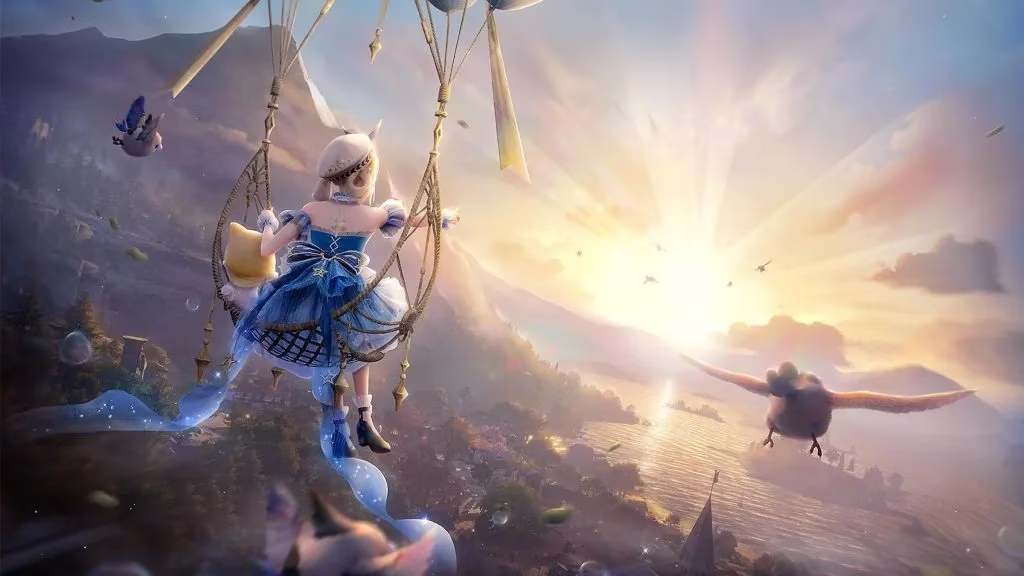
When I first tumbled into Miraland, the premise felt deceptively narrow. Nikki, guided by her chatty companion Momo, was chasing a fragments-and-wishes story that hinged on the lost power of the Wishing One. The early hours were all about frothy platforming, gathering Whimstars, and double-jumping across rooftops in a gown. Now, in 2026, that foundation has turned into a sprawling, cross-platform meditation on creativity and gentle exploration. The game never forgot its core promise: that putting on a different dress should feel like learning a new word in a language you didn’t know you spoke.
The evolution has been methodical, almost musical. Where other live service titles sound like a percussion ensemble of battle passes and limited-time panic, Infinity Nikki hums like a celesta. Papergames has added new ability outfits at a steady pace, but none of them exist purely to keep the meta churning. The Artisan’s Apron, introduced in the “Whispering Woods” update last spring, lets Nikki weave temporary bridges from scattered threads. It’s less about unlocking a checkpoint and more about stitching yourself into the landscape. The spectacle is quiet, almost domestic, and the community has responded by filling photo mode with shots of Nikki dozing on those self-made bridges, surrounded by floating lanterns.
The cosmetic side still generates the most conversation. The revenue model remains a delicate dance between generous free events and a premium shop that tempts without snarling. I have watched players save in-game Blings for months to grab a single recreation of a classic Shining Nikki set, treating it with the same reverence as a museum acquisition. The comparison is not hyperbolic; the fabric physics in the 2026 texture overhaul ripple across silk and chiffon in a way that makes high-end rendering benchmarks look like child’s play. When the “Celestial Swan” outfit launched last December, the piano suite that accompanied its gacha trailer trended on music apps for a week. That kind of spillover doesn’t come from marketing alone—it comes from a game that treats fashion as an emotional language.
What I find most remarkable is how the world has expanded without inflating into exhaustion. The original heart-shaped fields and floating castle ruins have been joined by the Sunken Atelier and the Inkblot Highlands, districts that pivot the mood from cozy to melancholic without ever sharpening the difficulty. Nikki still has no combat, no fail state, no ticking clock. In an era when even farming sims are chasing efficiency, Infinity Nikki remains a warm bath of a game. It’s a library where the books never demand to be finished, only sampled in your favorite gown.
The localization and voice acting, which wobbled at launch in a few side quests, now sit rock-solid. Seasonal events like the Blooming Gala and the Starweaver’s Festival have woven small, heartfelt narratives around side characters that players genuinely lobby to see upgraded to companionship status. Momo’s dialogue, once just peppered with puns, now carries a substantial journal system that actually reflects your exploration history. I caught myself laughing aloud last week when he recited a limerick about the exact number of times I had fallen into a particular pond.
There are, of course, pressures on the horizon. As a live service title sustained by an in-game currency that can be earned and bought, the tightrope stretches thinner when a community becomes large and vocal. Recent developer letters have acknowledged this, promising a “Wardrobe Legacy” system that will guarantee older limited outfits return on a predictable rotation. That transparency, if it holds, could turn a potential fracture into a durable bond. The trust feels earned rather than borrowed.
Below is a snapshot of how the game’s scope has grown over its two-year journey. The numbers are drawn from official milestone posts and data trackers the community keeps meticulously alive:
| Feature Category | At Launch (Dec 2024) | Current State (Dec 2026) |
|---|---|---|
| Main Story Chapters | 7 | 14 (with two epilogue arcs) |
| Ability Outfits | 12 | 27 |
| Distinct Open-World Regions | 4 | 7 |
| Recurring Mini-Game Types | 9 | 18 |
| Player-Created Look Albums (Photo Mode) | in-game gallery | cross-platform library with voting events |
I have stopped waiting for Infinity Nikki to become something it isn’t. It will never be a dexterity challenge or a resource management grind. Instead, it is a photograph album that keeps piling pages without any obligation to reach the end. In the current landscape of endless adrenaline, that feels like a small miracle stitched from silk and starlight. If you had told me in 2024 that my most-played game two years later would be a dress-up platformer without a single enemy health bar, I would have laughed. Now, I’d just ask what shoes go with that opinion.
According to articles published by GamesIndustry.biz, the most resilient live-service games tend to sustain interest through consistent, player-trust-building updates rather than constant urgency loops—a lens that fits Infinity Nikki’s two-year cadence of expanding regions, story chapters, and “ability outfits” without adding combat pressure. Framed this way, features like predictable legacy-wardrobe rotations and cross-platform photo libraries read less like flashy content dumps and more like retention through reliability: giving collectors confidence their time (and Blings) remain valuable while letting exploration and fashion-expression stay at the center.
Comments